
If you’ve ever felt pulled toward someone who keeps pushing you away, you’ve probably stumbled across the terms “fearful avoidant” vs. “dismissive avoidant.” These two attachment styles look similar on the surface. But underneath, they’re driven by completely different fears—and that changes everything.
Both types pull back from intimacy. Both can seem emotionally unavailable. But the reasons behind that behavior? Totally different. And once you understand those reasons, you start seeing patterns you couldn’t unsee.
What Is Attachment Theory? Anyway?
Before we get into fearful avoidant vs. dismissive avoidant, a quick background helps.
Attachment theory was developed by psychologist John Bowlby in the 1960s. It describes how early bonds with caregivers shape how we connect with others as adults.
There are four main attachment styles:
- Secure — comfortable with closeness and independence
- Anxious — craves connection, fears abandonment
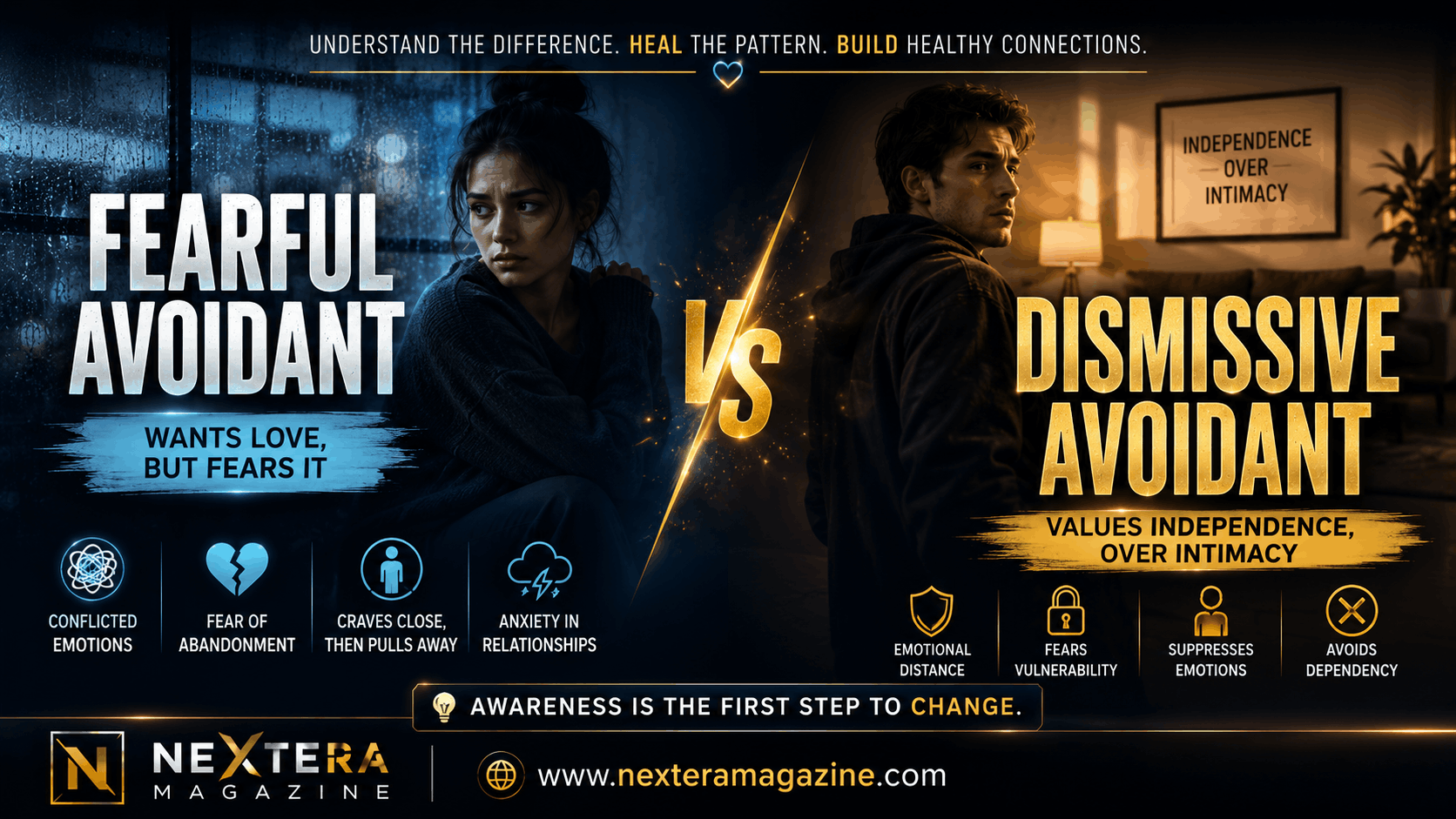
- Fearful avoidant — wants closeness but fears it
- Dismissive avoidant — values independence, suppresses emotional needs
Today we’re focusing on the last two. They’re the most commonly confused and the most misunderstood.
Fearful Avoidant vs Dismissive Avoidant: The Core Difference
Here’s the simplest way to put it.
A fearful avoidant person desperately wants love. But they also expect it to hurt. So they push people away before they can get pushed away first.
A dismissive avoidant person genuinely doesn’t feel much need for deep emotional connection. They’re not secretly longing for closeness. They’ve learned to self-soothe so well that others feel unnecessary.
I’ve noticed that people often assume dismissive avoidants are just “better at hiding” their fear. But that’s not quite right. Research suggests their emotional suppression is deeply ingrained from childhood, not a conscious defense.
That distinction matters. A lot.
How Each Style Shows Up in Relationships
The Fearful Avoidant Pattern
Fearful avoidants are sometimes called “anxious-avoidant. “And honestly, that label fits.
They’ll text you constantly — then ghost you for three days. They’ll say they love you—then pick a fight out of nowhere. It’s not manipulation. It’s fear running the show.
When things get too close, the alarm bells go off. Pull back. But when things feel too distant, different alarm bells ring. Come back.
This push-pull dynamic is exhausting — for them and for their partners.
A fearful avoidant often had unpredictable caregivers growing up. Love felt dangerous. So now, closeness triggers both longing and panic at the same time. The psychology behind this is well-documented — it’s called a “disorganized” attachment because there’s no coherent strategy for managing emotional needs.
The Dismissive Avoidant Pattern
Dismissive avoidants are often high-functioning, self-sufficient, and independent. They seem perfectly fine on their own. Because, in many ways, they are.
They don’t typically experience the emotional rollercoaster of a fearful avoidant. Instead, they tend to minimize the importance of relationships altogether.
“I don’t need anyone” is a pretty common internal narrative. And often, they genuinely believe it.
In relationships, they might seem checked out. Not cold or cruel — just… elsewhere. They’re not fighting the urge to connect. The urge just isn’t as loud for them.
Their caregivers were often emotionally unavailable but consistent. The child learned: don’t ask for too much; handle things yourself; feelings aren’t useful.
Fearful Avoidant vs Dismissive Avoidant: Triggers and Reactions
This is where things get really telling.
What triggers a fearful avoidant:
- Feeling too close (triggers panic and withdrawal)
- Feeling too distant (triggers anxiety and reaching out)
- Perceived rejection or criticism
- Vulnerability — giving or receiving it
What triggers a dismissive avoidant:
- Feeling smothered or controlled
- Someone being emotionally “needy”
- Being asked to prioritize the relationship over personal space
- Deep emotional conversations that feel unnecessary
So in a conflict, a fearful avoidant might escalate—cry, push, seek reassurance. A dismissive-avoidant might shut down—go quiet, leave the room, or stonewall.
Both are avoidance. Different flavors.
Can You Date a Fearful or Dismissive Avoidant?
Short answer: yes. But it helps to go in with clear eyes.
The fearful avoidant vs. dismissive avoidant distinction matters a lot when it comes to healing potential. Fearful avoidants often want to change. They feel the conflict between their desire for connection and their fear of it. That internal tension can actually motivate growth.
Dismissive avoidants may not see the problem at first. If they don’t feel much emotional pain from distance, they may not understand why their partner does. Change usually requires external feedback—or a relationship loss that finally breaks through the emotional wall.
In my experience, the most functional relationships with avoidants happen when there’s real self-awareness on their end. Not perfection. Just willingness to look inward.
Resources like Attached by Amir Levine and Rachel Heller have helped a lot of people understand these patterns—both in themselves and in partners.
Fearful Avoidant vs Dismissive Avoidant: The Healing Path
These are not fixed personality types. They’re coping strategies. And coping strategies can shift.
For fearful avoidants, the work often involves:
- Building a consistent sense of self-worth
- Learning that closeness doesn’t always mean danger
- Identifying the specific triggers that set off the push-pull cycle
- Therapy — especially trauma-informed approaches
For dismissive avoidants, the work often looks like this:
- Reconnecting with emotional needs that got suppressed early on
- Practicing staying present in uncomfortable emotional moments
- Allowing themselves to need others — even a little
- Learning that depending on someone isn’t the same as losing yourself
Neither path is quick. But both are genuinely possible.
How to Tell Which One You’re Dealing With
Still not sure if you’re looking at fearful-avoidant vs. dismissive-avoidant behavior? Here are a few quick tells.
Ask yourself (or notice):
- Do they seem conflicted? Fearful avoidant. They want closeness and fear it simultaneously.
- Do they seem… unbothered? Dismissive avoidant. Distance genuinely feels comfortable, not terrifying.
- Do they come back after pulling away? More common with fearful avoidants. Dismissive avoidants can detach cleanly.
- Do they talk about past relationships with bitterness or confusion? Fearful avoidant. Dismissive avoidants often recall exes with indifference.
These aren’t diagnostic tools. But they’re useful signals.
A Note on Self-Diagnosis
Attachment styles are a genuinely useful framework. But they can also become a way to avoid accountability.
“I’m dismissive-avoidant” shouldn’t be a pass for shutting your partner out indefinitely. And “I’m fearful avoidant” doesn’t excuse the push-pull harm that pattern can cause.
If you’re recognizing these patterns in yourself, that’s a great starting point. But real change usually needs more than a label. It needs consistent action — and often, professional support.
So Which Is Harder to Be in a Relationship With?
Honestly? Both are challenging. For different reasons.
Fearful avoidants create emotional turbulence. The highs feel very high. The crashes feel very low. It can feel addictive—in a way that’s worth examining.
Dismissive avoidants create emotional distance. There’s less drama. But there can also be a slow, quiet loneliness that creeps in over time.
The fearful avoidant vs. dismissive avoidant comparison isn’t really about which is “worse.” It’s about understanding what you’re working with—so you can decide what you actually want to do about it.
Final Thoughts
Understanding the fearful avoidant vs. dismissive avoidant split is genuinely useful. Not to judge or label the people in your life. But to understand the behavior—and stop taking it personally when it’s not about you.
Both styles developed for a reason. Both can change. And knowing the difference gives you a real edge — in relationships, in therapy, and in how you understand yourself.
Read Also: Conditional Love: What It Is and How It Affects You