
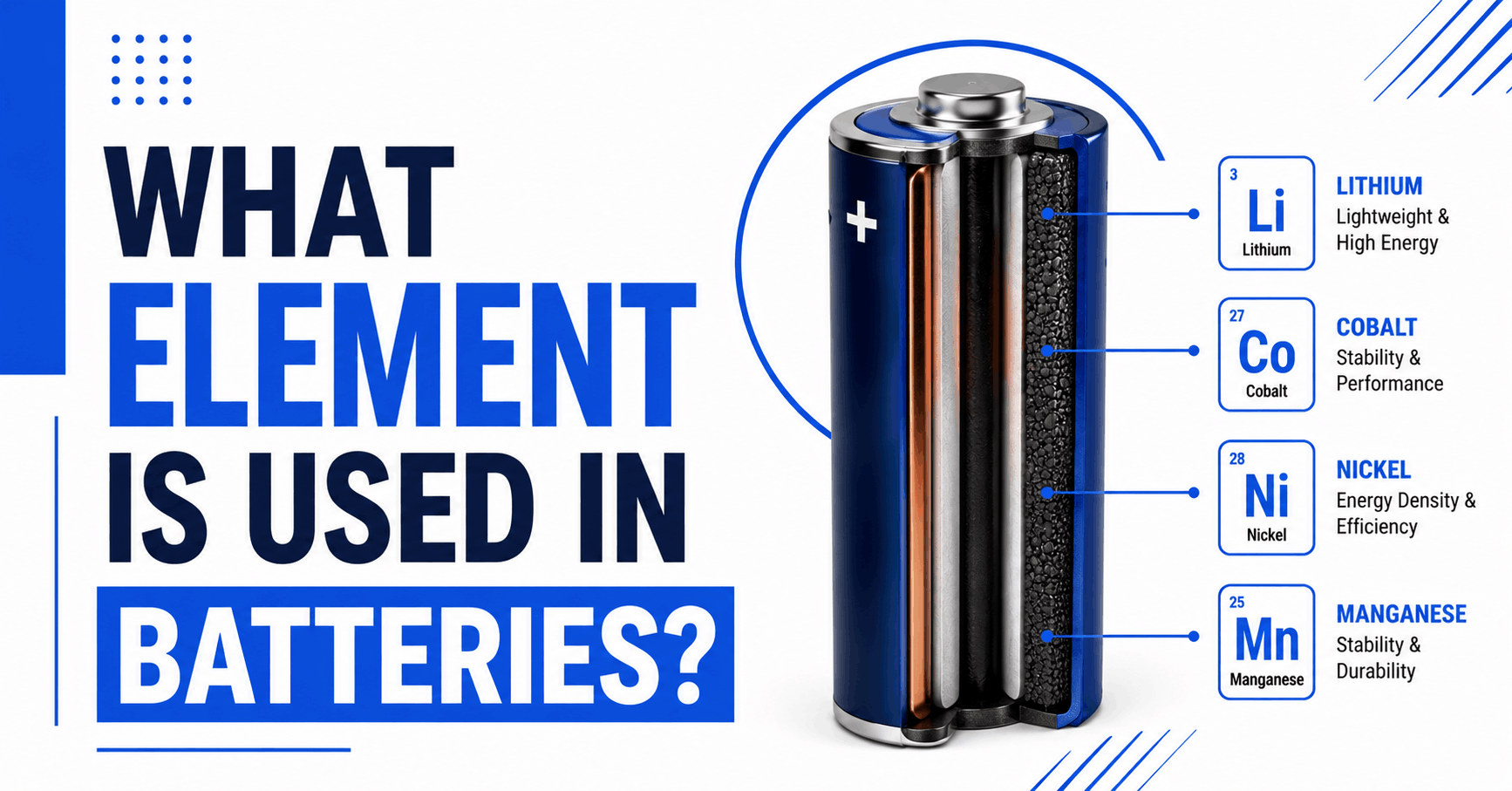
If you’ve ever cracked open an old remote or watched a battery swell up and thought, “What’s actually in this thing?” you’re not alone. The short answer to what element is used in batteries depends on which battery you’re holding, but for most devices, the answer is lithium.
That’s not the whole story, though. Batteries have been built from a handful of different elements for well over a century, and each one brings its own trade-offs in cost, safety, and how much energy it can pack into a small space.
The Short Answer to What Element Is Used in Batteries
Lithium is the element behind most rechargeable batteries you interact with daily: phones, laptops, electric vehicles, power tools, and increasingly, home energy storage systems. It’s light, it holds a lot of charge relative to its weight, and it reacts easily, which is precisely the property that makes a battery work in the first place.
But if you pop the hood on a gas car, you’ll find a lead-acid battery instead. Lead has been doing that job since the 1800s, and honestly, it’s still tough to beat for cheap, high-current starter batteries. So the real answer to what element is used in batteries is “it depends on the job,” and that’s what we’ll cover here.
Lithium: The Star Element in Modern Batteries
Lithium-ion batteries dominate consumer electronics for a simple reason: lithium is the third element on the periodic table, which means it’s incredibly light and gives up its electrons easily. That combination lets manufacturers build batteries with high energy density without making the device feel like a brick.
In my experience, this is the part people misunderstand most. They assume “lithium battery” means the whole thing is made of pure lithium metal, but that’s rarely true. Most lithium-ion cells use a lithium compound, often lithium cobalt oxide, lithium iron phosphate, or a nickel-manganese-cobalt blend, as the cathode material. The lithium ions shuttle back and forth between the cathode and the graphite anode during charging and discharging. You can read more about the underlying chemistry on Wikipedia’s lithium page, which covers where the element comes from and how reactive it actually is in its raw form.
One thing worth flagging: pure lithium metal is dangerous on its own. It reacts violently with water and needs careful handling. That’s part of why battery manufacturers use lithium compounds and layered safety systems rather than raw lithium metal in most consumer cells.
Other Elements That Show Up in Different Battery Types
Lithium gets the headlines, but plenty of other elements do important work in batteries you use without thinking about it.
Lead shows up in the acid battery under your car’s hood. It’s heavy and not great for the environment if disposed of carelessly, but it’s cheap to produce and can deliver the short, powerful burst of current a starter motor needs. Lead-acid batteries have been refined for so long that they’re reliable in a way newer chemistries still haven’t quite matched for that specific use case.
Nickel appears in a few older rechargeable formats, particularly nickel-cadmium (NiCd) and nickel-metal hydride (NiMH) batteries. You’ll still find NiMH cells in some hybrid vehicles and rechargeable AA batteries. Cadmium, which paired with nickel in older NiCd cells, has largely fallen out of favor because it’s toxic and heavily regulated in many countries now.
Zinc is another one worth knowing. It’s the element inside most disposable alkaline batteries, the ones you buy in a four-pack for a TV remote. Zinc-carbon and zinc-air chemistries also exist, and zinc-air actually powers many hearing aid batteries.
Manganese often works alongside zinc in alkaline cells, acting as the cathode material that helps the reaction along. And cobalt, along with graphite, plays a supporting role in many lithium-ion cathodes and anodes, which is part of why cobalt mining has become such a contentious topic in the supply chain conversation around EVs.
Why Lithium Became the Go-To Choice
It wasn’t inevitable that lithium would win out. For decades, nickel-cadmium and nickel-metal hydride were the standard for portable electronics. Lithium-ion technology only became commercially practical in the early 1990s, largely through work at Sony, and it took another decade or two before it fully displaced the older chemistries in most consumer gear.
What tends to surprise people is just how much of a difference energy density makes in practice. A lithium-ion cell can store roughly two to three times the energy of a same-sized nickel-cadmium cell. That’s the difference between a laptop that lasts eight hours and one that lasts three. Once smartphones and laptops needed that kind of runtime in a slim form factor, lithium wasn’t just the better option; it was close to the only viable one.
The U.S. Department of Energy has published detailed breakdowns of why lithium-ion chemistry became the backbone of electric vehicle batteries specifically, and the reasoning tracks with what happened in consumer electronics a decade earlier: better range, lighter packs, and faster charging.
How These Elements Actually Work Inside a Battery
Every battery, regardless of which element sits at its core, runs on the same basic principle. Two electrodes, called the anode and cathode, sit in an electrolyte that allows ions to move between them. When you use the battery, electrons flow from the anode to the cathode through your device, and ions move through the electrolyte to balance the charge. Charging reverses the process.
The element choice changes the voltage, the energy density, the safety profile, and the cost. Lithium gives you the best energy-to-weight ratio available at a commercial scale right now. Lead gives you cheap, reliable current delivery. Zinc gives you a stable, low-cost option for low-drain devices. None of these are objectively “the best” element for batteries in general; they’re just the best fit for a particular job.
Common Misconceptions Worth Clearing Up
Many people assume batteries are basically interchangeable once you strip away the branding. They’re not. Swapping a lithium-ion battery for a nickel-metal hydride one in the same device usually won’t work without redesigning the charging circuit, since the voltage curves and charging behavior differ significantly.
Another misconception is that “lithium battery” and “lithium-ion battery” mean the same thing. They don’t. Non-rechargeable lithium batteries, the kind you encounter in some cameras and medical devices, use metallic lithium directly and aren’t designed to be recharged at all. Lithium-ion batteries use a lithium compound and are built specifically for repeated charge cycles. Mixing these up, or trying to recharge a non-rechargeable lithium cell, is a genuine safety hazard.
Environmental and Supply Concerns Around Battery Elements
This part of the conversation has gotten a lot louder in the last few years, and for good reason. Lithium mining, particularly from brine deposits in South America and hard-rock mining in Australia, has raised questions about water use and local environmental impact. Cobalt sourcing, much of it tied to the Democratic Republic of Congo, has drawn scrutiny over labor conditions.
The International Energy Agency tracks these supply chains closely, since demand for battery elements is expected to grow substantially as electric vehicle adoption increases. If you’re curious about how mineral supply is tracked at a national level, the USGS National Minerals Information Center publishes annual data on lithium, cobalt, and nickel production and reserves.
As of mid-2026, battery manufacturers are actively working on reducing or eliminating cobalt from cathode chemistries, partly for cost reasons and partly to address these supply concerns. Lithium iron phosphate (LFP) batteries, which skip cobalt and nickel entirely, have picked up market share for exactly this reason, especially in lower-cost EVs. This is a fast-moving area, so if you need current figures on which chemistries dominate the market, it’s worth checking a source like the IEA directly rather than relying on older numbers.
Recycling and What Happens to These Elements Later
Battery recycling has become its own industry, partly driven by regulation and partly by the simple economics of recovering expensive elements like lithium and cobalt rather than mining new supply. Lead-acid batteries actually have one of the highest recycling rates of any consumer product, largely because lead is toxic and heavily regulated, and the recovery process is well established.
Lithium-ion recycling is trickier and still developing. The batteries are harder to disassemble safely, and the economics of recovering lithium specifically haven’t always been as favorable as recovering cobalt or nickel from the same cell. That’s changing as recycling technology improves and as raw material prices fluctuate, but it’s still behind lead-acid recycling in terms of maturity.
FAQs
What element is used in batteries the most today? Lithium, by a wide margin, for rechargeable batteries in consumer electronics and electric vehicles. Lead still leads in automotive starter batteries, while zinc dominates disposable alkaline batteries.
Is lithium a metal or an element? Lithium is a chemical element, specifically an alkali metal. It’s the lightest metal on the periodic table.
Can you replace lithium in batteries with something else? Researchers are actively exploring sodium-ion and other alternatives, partly to reduce reliance on lithium supply chains. Sodium-ion batteries are starting to appear commercially but generally offer lower energy density than lithium-ion cells right now.
Why don’t all batteries just use lithium? Cost, safety requirements, and application needs all play a role. A car’s starter battery needs to deliver a huge current burst cheaply and reliably, and lead-acid still handles that job well without the added complexity lithium chemistries require for safety management.
Is lithium dangerous? Pure lithium metal reacts strongly with water and needs careful handling. Lithium-ion batteries are generally safe when manufactured and used correctly, though damaged or poorly made cells can overheat, which is why proper charging equipment and avoiding physical damage both matter.
Read Also: AI Business & Marketing: A Practical Guide for 26