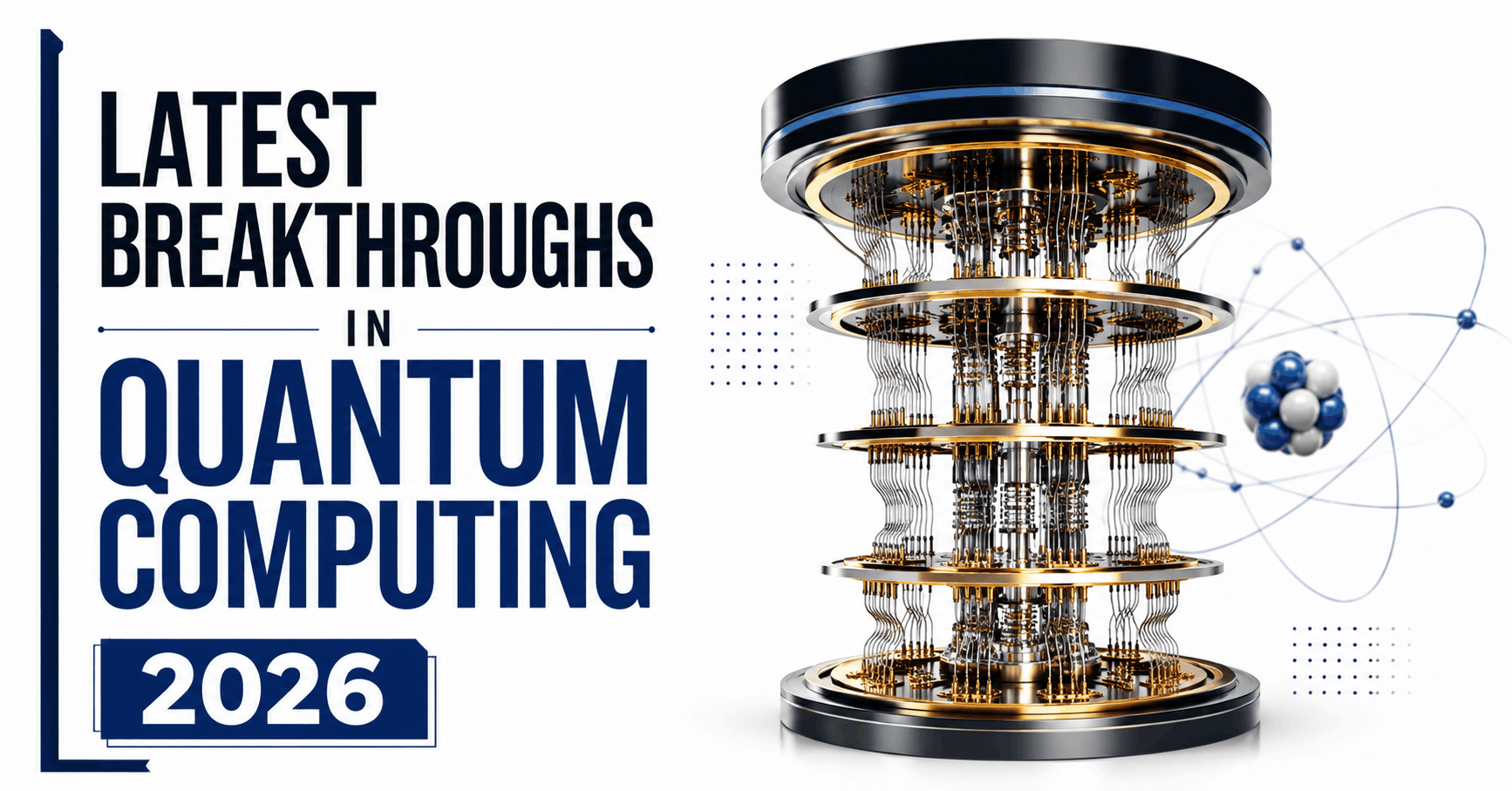
Something shifted in quantum computing this year, and it wasn’t just another lab demo with a press release attached. The latest breakthroughs in quantum computing, 2026, mark the point where the field stopped promising fault tolerance and actually started delivering pieces of it, in hardware, to paying customers. That’s a different conversation than the one we were having even eighteen months ago.
For years, the story was the same: more qubits, more noise, more caveats. This year, several of those caveats fell away at once. Here’s what actually happened, what it means, and where the hype still outruns the physics.
Error Correction Finally Behaves the Way Theorists Predicted
The single biggest shift in 2026 is that adding qubits to a quantum processor now reduces the error rate instead of making things worse. That sounds like a small technical footnote, but it’s the thing the entire field has been chasing since the 1990s.
Google’s Willow chip was the first to show this “below threshold” behavior at scale, and other groups have since replicated the pattern using different hardware approaches. In June, Atom Computing announced what it called the industry’s first full demonstration of quantum error correction using a toric code on a neutral-atom system, and the company framed it as proof that neutral atoms can compete directly with superconducting qubits on this front. You can read the full announcement from Atom Computing if you want the technical details straight from the source.
What tends to surprise people outside the field is how narrow this milestone still is. Below-threshold behavior means the physics works. It doesn’t mean the machines are big enough or fast enough to outperform a laptop on anything commercially useful yet. Those are two separate questions, and articles that blur them are usually the ones overselling the timeline.
Atom Computing’s and Microsoft’s Magne System Lands in Denmark
The most concrete piece of news this year isn’t a paper. It’s a machine. Atom Computing, working with Microsoft’s quantum software stack, has been installing a system called Magne for QuNorth, a Nordic quantum initiative backed by Denmark’s Export and Investment Fund and the Novo Nordisk Foundation. It’s being described as the world’s first commercially deployed “Level 2” quantum computer, meaning it uses error-corrected logical qubits rather than raw, noisy physical ones.
According to IEEE Spectrum’s coverage of the neutral-atom approach, Microsoft’s framework divides progress into three levels: noisy machines with a few hundred qubits, small error-corrected machines like Magne, and large-scale systems with hundreds of thousands of high-fidelity qubits. We’re not close to level three. But level two, arriving in an actual data center rather than a slide deck, is a real milestone.
In my experience in this space, most quantum announcements quietly die in the gap between “demonstrated in a paper” and “installed and running for a customer.” Magne clearing that gap, even on a small scale, is worth taking seriously.
A Room-Temperature Device That Skips the Deep Freeze
Not every 2026 breakthrough is about scaling qubit counts. One of the more remarkable results came out of Stanford, where researchers built a nanoscale optical device that entangles photons and electrons at room temperature, using twisted light instead of the extreme cooling that superconducting quantum systems normally require.
Most quantum hardware today needs to run colder than deep space, which is a huge part of why these systems are expensive and difficult to maintain. A working, room-temperature approach doesn’t replace superconducting or neutral-atom qubits overnight. But it does suggest a path toward smaller, cheaper components for specific tasks like secure communication and sensing. You can read more in ScienceDaily’s coverage of the Stanford research.
It’s still early-stage. One thing worth flagging here is that “room temperature” and “commercially viable” are not the same claim, and the Stanford team itself has been careful about that distinction.
Classical Computers Just Punched Back
Here’s a twist that got less attention than it deserved. Researchers at the Simons Foundation’s Center for Computational Quantum Physics, along with collaborators at Boston University, used a conventional computer and advanced tensor-network mathematics to solve a quantum simulation problem that had previously been claimed as evidence of quantum supremacy. They reportedly ran part of the calculation on a personal laptop. Details are in the Simons Foundation’s writeup of the result.
This isn’t a setback for quantum computing so much as a reality check on how we measure it. Every time a classical algorithm catches up to a claimed quantum advantage, the bar for what counts as genuine supremacy moves higher. That’s healthy. It also means some of the loudest “quantum beats classical” headlines from the past few years deserve a second look.
The Geopolitical Race Behind the Lab Results
None of this is happening in a vacuum. China has committed roughly $10 billion to its National Laboratory for Quantum Information Sciences and named quantum technology a strategic priority in its current five-year plan. Australia has backed PsiQuantum with hundreds of millions in public funding. Japan has received an error-correction-ready system from QuEra, and Canada is pushing forward with space-based quantum key distribution research.
The competitive framing matters because it’s driving real capital into hardware, not just software promises. Governments tend to fund infrastructure they think will matter strategically, and the fact that so many are moving at once says something about how seriously the risk of quantum-capable code-breaking, sometimes shorthanded as “Q-Day,” is now being treated. For background on the underlying concept, Wikipedia’s entry on quantum error correction is a solid, non-hyped starting point.
What This Actually Means for Businesses Right Now
If you’re evaluating quantum computing for your organization in 2026, the honest answer is that direct use is still limited to a small set of research pilots, mostly in finance, pharmaceuticals, and logistics, where hybrid quantum-classical workflows are being tested for narrow optimization and simulation problems. Full replacement of classical infrastructure isn’t on the table this year and probably won’t be for a while.
What’s changed is the confidence level. A year ago, most quantum roadmaps were built on hope. Now they’re built on machines that exist and error rates that behave the way theory predicted. That’s a meaningful difference even if the practical payoff is still mostly ahead of us.
For most companies, the useful move right now isn’t buying quantum hardware. It’s building internal literacy, tracking which vendors are actually shipping (rather than announcing), and staying alert to the cybersecurity side, since post-quantum encryption standards are already being rolled out ahead of any working code-breaking machine.
What’s Still Unclear
A few things are genuinely open questions, and it’s worth saying so plainly rather than pretending otherwise.
Nobody has a fault-tolerant, million-qubit machine, and nobody expects one this year or next. The “Level 2” systems like Magne are small, expensive, and aimed at research and early industrial use rather than broad commercial deployment. And the classical-versus-quantum performance gap keeps moving as classical algorithms improve, which makes any single supremacy claim harder to trust at face value.
None of that erases the progress. It just means the timeline for something genuinely transformative is still measured in years, not months.
FAQs
Is quantum computing actually useful yet? For narrow research and pilot applications in fields such as drug discovery and logistics optimization, the answer is yes, but only in limited ways. For general-purpose computing tasks, not yet.
What does “error-corrected” or “logical qubit” mean? A logical qubit is built from multiple physical qubits working together so that errors in individual qubits can be detected and corrected, producing a more reliable unit of computation. It’s the foundation of any large-scale, fault-tolerant quantum computer.
Which companies are leading in 2026? Google; Microsoft, with Atom Computing; IBM; and QuEra are among the most visible, each pursuing different hardware approaches (superconducting, neutral-atom, and others).
Should businesses worry about quantum computers breaking encryption soon? Not immediately, but the risk is serious enough that organizations are already adopting post-quantum cryptography standards ahead of any working large-scale quantum computer. Waiting until it’s a live threat isn’t a great strategy.
Where can I track ongoing developments? Official sources from the companies involved, along with outlets like IEEE Spectrum, tend to separate real milestones from speculative hype better than general tech news aggregators.
Read Also: AI Business & Marketing: A Practical Guide for 26