
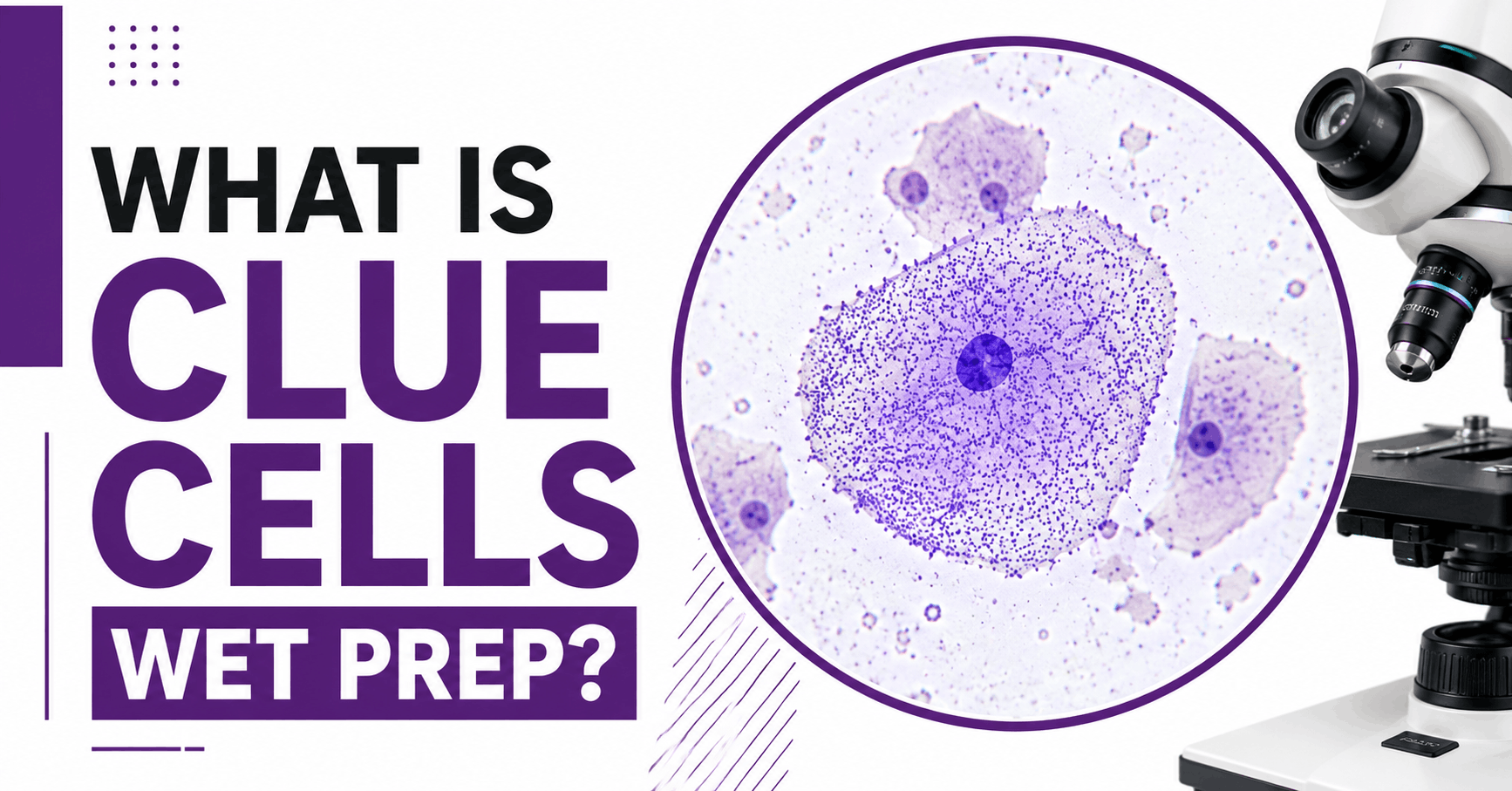
If your doctor mentioned a “wet prep” during a pelvic exam and then said something about clue cells, you’re probably wondering what that actually means for your health. So let’s clear it up. A wet prep (short for wet mount preparation) is a simple lab test where a sample of vaginal discharge gets mixed with saline and looked at under a microscope. Clue cells are one of the specific things a doctor or lab tech is searching for on that slide, and finding them is one of the strongest clues (pun intended) that you’re dealing with bacterial vaginosis, or BV.
What Clue Cells Actually Are
Clue cells are vaginal epithelial cells, the flat skin-like cells that line the walls of the vagina, that have become coated with bacteria. Under normal conditions, these cells look clean and have a smooth, distinct edge. When bacteria such as Gardnerella vaginalis and other anaerobic organisms overgrow, they attach themselves to the surface of these cells in thick clusters. The result is a cell whose border looks fuzzy, stippled, or granular instead of crisp, almost like it’s been dusted with pepper.
That fuzzy appearance is the whole point of the name. A “clue” cell gives the lab tech a visual clue that something in the vaginal microbiome has shifted out of balance. In my experience, once you’ve seen a genuine clue cell next to a normal epithelial cell, the difference is pretty obvious, even to someone without years of microscopy training. It’s not a subtle call in most cases.
Why the Wet Prep Test Exists
Vaginal wet mount testing has been around for decades because it’s cheap, fast, and doesn’t require sending anything off to an outside lab. A clinician takes a swab of discharge during a pelvic exam, places a small amount on a glass slide, adds a drop of saline, and looks at it right there in the office under a wet mount setup. Within a few minutes, they can usually tell whether they’re looking at yeast, trichomonas, normal flora, or bacterial vaginosis.
This matters because BV, yeast infections, and trichomoniasis often produce overlapping symptoms, itching, unusual discharge, odor, and mild irritation. Treating the wrong one won’t help and can actually prolong the problem. A wet prep gives real-time information instead of guessing based on symptoms alone.
How Clue Cells Fit Into a BV Diagnosis
Doctors don’t usually rely on clue cells by themselves. The classic method is called the Amsel criteria, and it looks at four things together: a thin, grayish-white discharge, a vaginal pH above 4.5, a fishy odor that gets stronger when a drop of potassium hydroxide is added (often called the whiff test), and the presence of clue cells on the wet mount. Meeting at least three out of four of these usually confirms BV.
Clue cells tend to be the most specific of the four signs. A high pH or an odor can happen for other reasons, but a slide loaded with clue cells is hard to explain any other way. That’s why many clinicians treat their presence as the deciding factor when the other signs are borderline. According to the CDC, bacterial vaginosis is the most common vaginal condition among women of reproductive age, which is part of why this test gets used so often.
What Happens During the Actual Test
The process itself is quick and, honestly, not much different from a routine pelvic exam. A speculum is used to visualize the vaginal walls, and a cotton or synthetic swab collects a small discharge sample. That sample gets placed on one or two slides. One slide often gets a saline solution for the wet mount (to check for clue cells and Trichomonas), and a second sample sometimes gets potassium hydroxide added to check for yeast and to perform the whiff test.
The slide is then examined under a standard light microscope, usually at a magnification that lets the tech clearly see individual epithelial cells and the bacteria sitting on their surface. There’s no fasting required, no special prep beforehand, and results come back within minutes rather than days. Some clinics do ask you to avoid douching or vaginal products for 24 to 48 hours before the visit, since these can wash away or dilute the very discharge being tested.
What a Positive Result Actually Means
If your wet prep comes back showing clue cells, it generally means the balance of bacteria in your vagina has shifted away from the protective lactobacilli species and toward an overgrowth of other organisms. This isn’t the same as a sexually transmitted infection, even though BV is sometimes lumped in with STIs in casual conversation. It can happen in people who’ve never been sexually active, though sexual activity, new or multiple partners, and douching are all recognized risk factors.
One thing worth flagging is that having clue cells on a slide doesn’t automatically mean you need to feel alarmed. BV is common and treatable, and for a lot of people it resolves on its own or with a short course of prescribed antibiotics such as metronidazole or clindamycin. What tends to surprise people is how often BV shows up with no symptoms at all. Some clue cells get discovered incidentally during a routine exam or pap smear workup, not because the patient came in complaining of discharge or odor.
What a Negative Result Means
Not seeing clue cells is reassuring, but it doesn’t rule out every possible issue. A wet prep can also come back showing yeast (budding cells and hyphae), motile trichomonads swimming across the slide, or simply normal flora with lactobacilli dominating the picture. If your symptoms persist despite a negative wet prep, that’s a signal to ask for follow-up testing rather than assume nothing’s wrong. Some labs now use PCR-based tests or Mayo Clinic-style nucleic acid amplification panels alongside or instead of a wet mount, especially when the microscopy result is ambiguous.
Common Misconceptions About Clue Cells
A few mix-ups come up again and again with this topic. Clue cells are not a type of infection on their own; they’re a visual marker that reflects bacterial overgrowth. They’re also not evidence of poor hygiene. BV happens because of shifts in the natural vaginal microbiome, and scrubbing harder or douching more often usually makes things worse, not better, because it strips out the protective bacteria along with everything else.
Another misconception is that a wet prep is only useful for BV. In reality the same slide often reveals multiple things at once, which is part of why it remains a first-line tool in gynecology offices and urgent care clinics alike, even with newer molecular tests available.
Limitations of the Wet Prep Method
The test depends heavily on the skill of whoever is reading the slide. Interpretation is somewhat subjective, and a borderline case can be read differently by two different technicians. Sample quality matters too; if the swab doesn’t pick up enough discharge, or if the sample dries out before it reaches the microscope, results can be inconclusive. Because of this, some larger labs now pair wet prep findings with molecular diagnostics for confirmation, particularly in recurrent or unclear cases.
It’s also a snapshot in time. Vaginal flora can shift day to day, around your menstrual cycle, after intercourse, or during pregnancy, so a single negative wet prep doesn’t guarantee the picture will look the same a week later if symptoms return.
Frequently Asked Questions
Does finding clue cells always mean I have bacterial vaginosis? Not on its own. Clue cells are one part of the Amsel criteria, and doctors usually weigh them alongside pH, odor, and discharge appearance before confirming a BV diagnosis.
Is a wet prep painful? No. It uses the same speculum exam most people already associate with a pelvic exam or pap smear. There might be brief discomfort from the speculum itself, but the swab collection is quick.
Can clue cells show up if I don’t have any symptoms? Yes, and this happens more often than people expect. BV can be asymptomatic, which is why it sometimes gets picked up incidentally during an unrelated visit.
How is BV treated once clue cells confirm the diagnosis? Typically with prescription antibiotics, either oral metronidazole or topical clindamycin, depending on your history and preference. Your provider will guide you on the right option and duration.
Can I test for clue cells at home? Standard wet prep microscopy isn’t something you can do at home since it requires a microscope and trained interpretation. Some at-home BV screening kits test vaginal pH instead, but they can’t replace a lab-confirmed diagnosis if symptoms are persistent or severe.
Does a wet prep test for STIs too? Not directly, though the same visit often includes separate STI testing. A wet prep specifically screens for BV, yeast, and trichomoniasis rather than chlamydia, gonorrhea, or HIV.